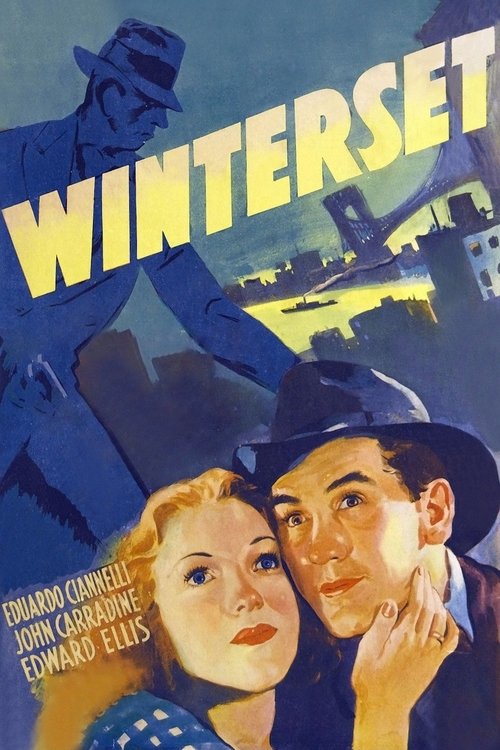
Winterset(1936)
12/03/1936 (US)Romance, Crime, Drama1h 17m
5.7
Overview
A man is determined to find the real culprit behind the crime for which his father was wrongly executed.
Alfred Santell
Director
Anthony Veiller
Screenplay
Top Billed Cast




Where to Watch
Stream




Rent
Buy
Powered by JustWatch
Popularity Trend
Last 30 Days
This chart shows the popularity trend over the past 30 days.
Media
Social
C
A review by CinemaSerf
6.0
Written on August 7, 2025
I thought Burgess Meredith turned in quite a characterful performance in this otherwise rather dry drama. He is “Mio” whose late father we have already seen at the top of the film being condemned to the chair for his part in a robbery. Now, a generation later he is determined to prove that he was innocent. What quickly becomes apparent is that the investigation at the time was largely based around the “if your face fits” theory, and it doesn’t take “Mio” very long to get onto the trail of a far more likely culprit. Meantime, we also discover that a speech made by his dad upon sentencing declaring his innocence and warning the judge that his will be a sort of living death from now on has turned out to be eerily true. That judge (Edward Ellis) has indeed somewhat lost the plot, and is a ghost of his former self wandering the streets with little memory of who he is or was. It might well be that “Mio” could be in a position to salvage more than one should here? The plot clearly seeks to highlight the difficulties for the poverty stricken, slum-dwelling, population of the USA to not just get by in life, but to get a fair hearing from authority. That’s not just the court proceedings, but also far more rudimentary aspects of freedom. Even an assembly to dance attracts the police. Ultimately, though, it really does come down to a straightforward style of good and evil, and with the underplayed but effectively sinister effort from Eduardo Ciannelli and a really quite impactful one from Ellis, this can at times be quite a poignant evaluation. Alfred Santelli hasn’t done so much to creatively adapt it from the stage though, and that straight transfer to celluloid sees it lose quite a bit of it’s intensity. Even with the romantic attachment to “Miriamne” (Margo), much of the intimacy is gone, the dialogue is all too often delivered as if it were set-piece monologues, and none of the characters really come together until very near the end. Just taking it from the theatre to the cinema was always going to compromise some of the nuance, and though this is still a decent effort it just misses a little of the story’s soul.